


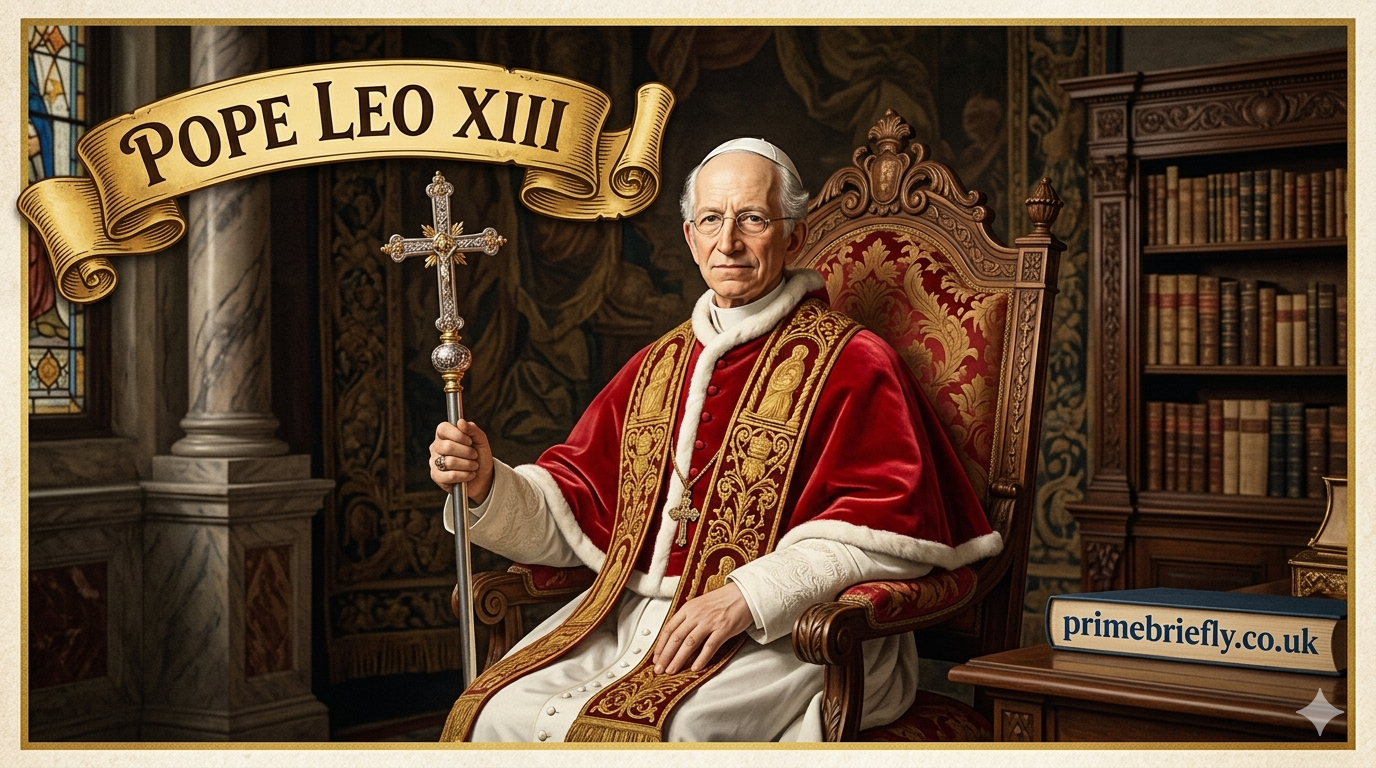
Pope Leo XIII remains one of the most influential and intellectually significant figures in the history of the Roman Catholic Church. His papacy, which lasted from 1878 to 1903, marked a turning point in how the Church engaged with modern political thought, social issues, philosophy, and science. Known for his deep intellectualism and forward-thinking approach, he is often remembered as the “social pope” due to his groundbreaking teachings on labor rights and social justice.
This article explores his early life, papal journey, Pope Leo XIII major contributions, theological impact, and the lasting legacy he left on the Catholic world and beyond.
Early Life and Formation
Pope Leo XIII was born as Vincenzo Gioacchino Pecci on March 2, 1810, in Carpineto Romano, a small town in the Papal States (modern-day Italy). He came from a noble but modest family, which allowed him access to education and religious training from a young age.
His intellectual abilities were recognized early, and he was sent to study at the Jesuit College in Viterbo and later at the Roman College. He eventually completed his theological studies at the Academy of Ecclesiastical Nobles, an institution designed to prepare young men for diplomatic service in the Church.
Pecci was ordained a priest in 1837. His early career quickly moved beyond pastoral duties, as he entered the Vatican diplomatic service. His intelligence, organizational skills, and diplomatic approach led to rapid promotions within the Church hierarchy.
Rise Through the Church Hierarchy
Before becoming pope, Pecci served in several important roles:
- Apostolic Delegate to Benevento
- Archbishop of Perugia
- Cardinal appointed by Pope Gregory XVI in 1853
As Archbishop of Perugia, he gained a reputation for being both spiritually grounded and socially aware. He worked on improving education, supporting charitable institutions, and engaging with the intellectual challenges of the time.
His years in Perugia were especially important because Pope Leo XIII they shaped his understanding of the struggles of ordinary people. This later influenced his papal teachings on labor rights and economic justice.
Election as Pope Leo XIII
In 1878, following the death of Pope Pius IX, the conclave elected Vincenzo Pecci as the new pope. He took the name Leo XIII, signaling a connection to earlier papal traditions while also indicating a new direction.
At the time of his election, many expected a short or transitional papacy due to his age—he was already 68 years old. However, he surprised the world by serving for 25 years, making him one of the longest-reigning popes in history.
From the beginning of his papacy, Leo XIII demonstrated a desire to engage with the modern world rather than isolate the Church from it.
Intellectual Vision and Philosophical Approach
One of the defining features of Pope Leo XIII’s leadership was his intellectual depth. He believed that the Church should not reject modern philosophy and science but rather engage with them critically and constructively.
He was especially influenced by the teachings of Thomism. He promoted a revival of Thomistic philosophy, which emphasizes reason and faith working together. In 1879, he issued the encyclical Aeterni Patris, encouraging Catholic institutions to return to the study of St. Thomas Aquinas.
This move had a profound impact on Catholic education and remains influential in seminaries and theological institutions today Pope Leo XIII.
Social Teachings and the Birth of Catholic Social Doctrine
Perhaps the most significant contribution of Pope Leo XIII was his development of modern Catholic social teaching. His landmark encyclical Rerum Novarum (1891) addressed the challenges of industrialization, workers’ rights, and economic inequality.
In this document, he addressed key issues such as:
- Fair wages for workers
- The right to private property
- The importance of labor unions
- The responsibilities of employers toward employees
- The moral limits of capitalism and socialism
He rejected both unchecked capitalism and radical socialism, proposing instead a balanced approach rooted in human dignity and moral responsibility.
The teachings found in Rerum Novarum laid the foundation for what is now known as Catholic social doctrine, influencing later popes and global discussions on labor rights.
Relationship with Modern Political Thought
During Pope Leo XIII’s reign, Europe was undergoing major political and social changes. The rise of industrial capitalism, socialism, and secular governments posed challenges to the Church’s traditional authority.
Rather than opposing all modern developments, Leo XIII chose a more nuanced approach. He encouraged Catholics to participate in civic life and engage with political systems while maintaining their moral principles.
He also emphasized the importance of natural law—a philosophical idea that suggests moral principles are rooted in human nature and reason. This concept allowed the Church to dialogue with secular political systems on shared ethical foundations.
Diplomatic Efforts and Global Influence
Pope Leo XIII was also a skilled diplomat. He worked to improve relations between the Vatican and various European governments, many of which had strained ties with the Church following the unification of Italy.
He strengthened the global presence of the Catholic Church by:
- Encouraging missionary work worldwide
- Establishing new dioceses
- Supporting Catholic education globally
- Engaging with leaders of non-Christian religions
He also made efforts to improve relations with the Eastern Orthodox Church and Protestant communities, promoting a spirit of dialogue rather than confrontation.
Contributions to Theology and Education
Leo XIII placed great importance on education and intellectual formation. He believed that ignorance was one of the greatest threats to faith and society.
He supported the development of Catholic universities and seminaries and encouraged the study of philosophy, theology, and science together.
He also emphasized biblical studies and encouraged scholars to engage critically with Scripture while maintaining respect for tradition.
His encyclicals often addressed complex theological questions in a way that made them accessible to both clergy and educated laypeople.
Devotion and Spiritual Life
Despite his intellectual focus, Pope Leo XIII was deeply spiritual. He had a strong devotion to the Rosary and encouraged Catholics worldwide to pray it regularly.
He wrote several encyclicals dedicated to the Rosary, promoting it as a powerful spiritual tool for peace and personal holiness.
He also emphasized the importance of prayer, moral discipline, and devotion to the Sacred Heart of Jesus.
His spiritual teachings balanced intellectual rigor with deep personal faith, making his papacy both practical and devotional.
Relationship with Science and Modern Thought
Unlike some of his predecessors, Leo XIII showed openness toward scientific inquiry. He believed that science and faith were not enemies but could complement each other when properly understood.
He encouraged Catholic scholars to study natural sciences and engage in intellectual dialogue with contemporary scientific theories.
This approach helped reduce tensions between the Church and the scientific community during a time of rapid technological advancement.
Challenges During His Papacy
Despite his achievements, Leo XIII faced several challenges:
- Loss of papal political power following the unification of Italy
- Rise of secularism in Europe
- Growth of anti-clerical movements
- Internal debates within the Church about modernization
He responded to these challenges with diplomacy, intellectual engagement, and theological clarity rather than confrontation.
Final Years and Death
Pope Leo XIII remained active well into old age. Even in his 90s, he continued to write encyclicals and manage Church affairs.
He died on July 20, 1903, at the age of 93. His death marked the end of an era, as he had been one of the oldest and longest-serving popes in history.
He was succeeded by Pope Pius X.
Legacy and Long-Term Impact
The legacy of Pope Leo XIII is vast and continues to influence the modern Catholic Church in several ways:
1. Social Justice Teachings
His ideas in Rerum Novarum continue to shape Catholic social teaching on labor rights and economic justice.
2. Philosophical Revival
His promotion of Thomistic philosophy remains central to Catholic education.
3. Church and Modern World Dialogue
He established a model for engaging with modern political and intellectual movements.
4. Global Expansion of the Church
His support for missionary work helped expand Catholicism worldwide.
5. Intellectual Tradition
He reinforced the idea that faith and reason are compatible.
Conclusion
Pope Leo XIII stands as a towering figure in Church history, not only because of the length of his papacy but because of the depth of his intellectual and moral influence. He guided the Catholic Church through a period of immense social and political change, offering a balanced and thoughtful response to modern challenges.
His teachings continue to resonate in discussions about justice, economics, philosophy, and faith. More than a historical figure, he remains a symbol of how tradition and modernity can coexist in meaningful dialogue.
The life and work of Pope Leo XIII continue to inspire scholars, theologians, and believers around the world, making him one of the most important popes of the modern era.
